
Autos & Capital
Meet Musk’s Spruce Goose
Tesla finally showed the Roadster — and a carbon-wrapped sphere of compressed air that lets it leap over cars. Howard Hughes would recognize the move. So would anyone who has ever sat across the table from a showpiece asset.
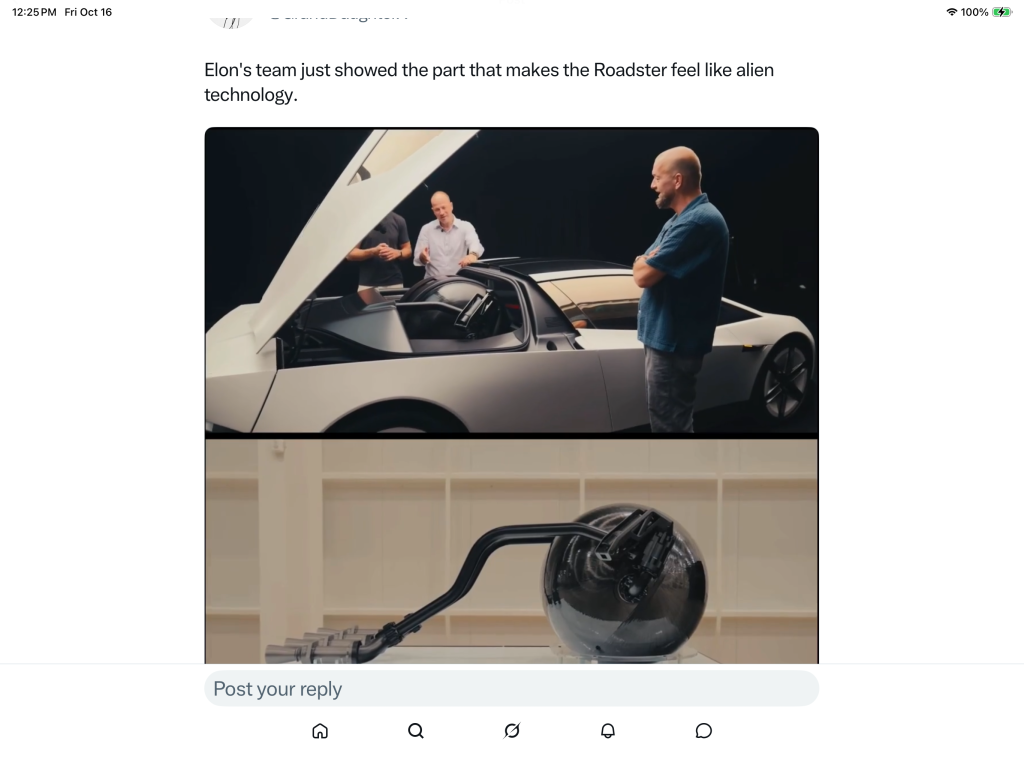
The photograph making the rounds this week is not of the car. It is of a black sphere the size of a beach ball, a bent tube snaking out of it, and a cluster of stubby nozzles at the end. That is the part, as one viral post put it, that makes the new Tesla Roadster feel like alien technology. It is also the part that tells you exactly what kind of asset the Roadster is.
On Thursday, October 15, at SpaceX’s test site in McGregor, Texas, Tesla unveiled the production version of the second-generation Roadster — nine years after the car was first shown, and six years after it was originally due. The demonstration was real hardware, not a render. Underbody fans pulled the car up an inverted ramp. Then cold-gas thrusters fired and the Roadster hopped clean over five other Teslas.
Tesla’s vehicle engineering chief, Lars Moravy, told the audience the demo car runs ten thrusters fed by roughly 600 liters of rechargeable compressed air. The sphere in the photo is the reservoir: a composite overwrapped pressure vessel, the same family of hardware SpaceX flies on Falcon 9 and Dragon. Nothing burns. High-pressure air goes in, gets dumped through shaped nozzles, and the reaction pushes the car. Musk sketched exactly this in 2018 — a pressure vessel in place of the rear seats — and, give him credit, he built it.
The terms sheet
Here is what Tesla put on the table. Three trims. A “Performance” model, reservable for $50,000. A “Thrust” model with rear thrusters and a claimed 0–60 under one second, reservable for $250,000 (the demo clocked 0.81). And a single-seat “Rocket,” with thrusters around the perimeter for lift and rotation, available by invitation only. Production is slated for 2028.
What Tesla did not put on the table is just as instructive: no final price for any version, no answer on whether the thrusters will be street-legal — Musk’s reply was, more or less, that it depends on your street — and no explanation of how a car that vents high-pressure air at bystanders clears a federal safety review.
And then Musk said the quiet part out loud. Asked about the business impact, he allowed that he is
“not sure it moves the needle massively from a revenue standpoint.” — Elon Musk, Oct. 15, 2026
That is an honest sentence, and it is the key to reading the whole event.
Long Beach, 1947
On November 2, 1947, Howard Hughes taxied the H-4 Hercules into Long Beach Harbor, ostensibly for water tests. Then he opened the throttles and lifted the thing roughly seventy feet off the water for about a mile. It was the largest airplane ever built — a 320-foot wingspan, made of laminated wood because wartime aluminum was rationed. The press called it the Spruce Goose. Hughes hated the name. It was mostly birch.
The Hercules had been ordered in 1942 as a troop and cargo transport that could cross the Atlantic above the U-boats. It arrived after the war was over. By the time it flew, Hughes was defending it before a Senate committee investigating whether the government had paid for a white elephant. The flight was his rebuttal: it flies. It never flew again. Hughes kept it in a climate-controlled hangar, crew on payroll, until he died.
Read that history closely and the lesson is not “the Spruce Goose was a failure.” The engineering was genuine. The flight was genuine. The problem was that it answered a question nobody was asking anymore, at a price no one could justify, while the man behind it was answering a different question entirely — whether he could be trusted.
What the workout table sees
I spent years on the restructuring side of the aviation business — Eastern, Trump Shuttle, Continental, LearJet. You learn to sort a company’s assets into two piles: the ones that throw off cash, and the ones that throw off headlines. Both have value. Only one services debt.
The Roadster belongs in the second pile, and Musk just said so himself. Its job is not to sell in volume. Its job is to remind investors, at a moment when Tesla’s core car business faces real competition, that the company can still do something nobody else can. That is a legitimate job. Halo cars have done it for Ferrari, Porsche, and Ford’s GT program for decades.
But a few items deserve a hard look before anyone wires a quarter-million dollars:
The deposit is a loan. A $250,000 reservation on a car with no final price and a delivery date two years out is, functionally, an interest-free unsecured advance from the customer to the manufacturer. Roadster buyers have been here before; reservations were first taken in 2017. Read the refund terms the way a creditor would.
The certification risk is open-ended. A road car that fires pressurized gas sits in regulatory territory nobody has mapped. If the thrusters end up track-only, the “Thrust” trim is a very expensive show car with an air tank where the back seats used to be.
The real asset may be the transfer, not the car. This is where the Hughes comparison cuts in Musk’s favor. Hughes’s wooden airplane was a dead end, but the organization around him became Hughes Aircraft, a defense electronics powerhouse. If the Tesla–SpaceX collaboration on pressure vessels, nozzles, and electric actuators produces anything useful beyond a jump over five Model Ys, the Roadster will have earned its keep regardless of unit sales.
It flies. Now what?
Hughes proved his airplane could fly, and that settled the argument he was having with the Senate. It did not settle the argument with the market, which had already moved on to aluminum, land-based runways, and the jet age.
Musk has now proved his car can jump. That settles the argument about whether the 2018 promise was real. The open question — the one that actually moves the needle — is whether the company that made it can get back to making the cars that pay for it, at the volume and margins that justify the stock. A sphere of compressed air is a magnificent piece of engineering. It is not a business plan.
Ruhlman Thought: Every great builder eventually makes one thing purely to prove he still can. The wise ones keep it in the hangar and go back to work. “In all labour there is profit: but the talk of the lips tendeth only to penury” (Proverbs 14:23).